
丨
English
Views: 0 Author: Site Editor Publish Time: 2026-10-09 Origin: Site


Heavy-duty truck assembly lines require strict predictability. Component mismatches routinely lead to costly downtime, elevated scrap rates, and delayed production schedules. Manufacturers must secure reliable parts to keep commercial vehicle assembly moving efficiently. A single out-of-tolerance part can halt an entire shift.
While newer lightweight alloys exist, standard Gray Iron Castings remain a baseline requirement for specific truck applications. They provide a unique balance of thermal conductivity, vibration damping, and manufacturing efficiency. Finding the precise match between material grade and operational stress dictates long-term vehicle reliability. You need components built to handle immense mechanical stress.
This guide breaks down the engineering criteria, machining tolerances, and foundry evaluation steps required to seamlessly integrate these parts. You will learn how to align material specifications with distinct component functions. We also explore the critical transition from raw materials to assembly-ready components in an OEM or Tier-1 truck manufacturing environment.
Application matching: Successful integration requires aligning specific ASTM A48 gray iron classes (e.g., Class 30 vs. Class 40) with exact part stresses (e.g., brake drums vs. engine blocks).
Assembly efficiency: Specifying machined gray iron castings rather than raw castings reduces supply chain friction and shifts quality assurance burdens to the foundry.
Vendor evaluation: Shortlisting foundries should prioritize those with proven PPAP (Production Part Approval Process) capabilities, verifiable scrap rate data, and automated molding lines for high-volume consistency.
Truck manufacturers constantly weigh material performance against assembly viability. Gray iron presents a compelling engineering profile. It relies on a microstructure filled with graphite flakes. These flakes interrupt the metal matrix. They create a material highly capable of absorbing energy.
Superior vibration damping stands out as its primary strength. Commercial trucks generate severe NVH (Noise, Vibration, and Harshness) levels. Gray iron naturally absorbs these vibrations better than carbon steel. This characteristic protects adjacent engine and transmission components from premature fatigue. Furthermore, the material offers exceptional machinability. The internal graphite flakes act as a natural lubricant. Machining tools cut through the iron faster and last much longer. Gray iron also provides high thermal capacity. It absorbs and dissipates intense heat rapidly, preventing warpage under thermal load.
However, engineering teams must acknowledge strict limitations. Gray iron exhibits lower tensile strength than ductile iron or forged steel. It fractures rather than bends under extreme impact. It lacks ductility. You cannot specify it for load-bearing suspension arms or chassis cross-members subjected to heavy twisting forces.
Given these constraints, OEMs deploy this material in highly specific, justified applications. You will commonly find it specified for:
Brake rotors and drums: Capitalizing on rapid heat dissipation.
Engine blocks: Utilizing vibration damping to quiet heavy diesel engines.
Flywheels: Relying on mass and stability to maintain rotational inertia.
Pump housings: Benefiting from complex internal geometries cast with high precision.
Transmission cases: Using the rigid structure to house intricate gear assemblies.
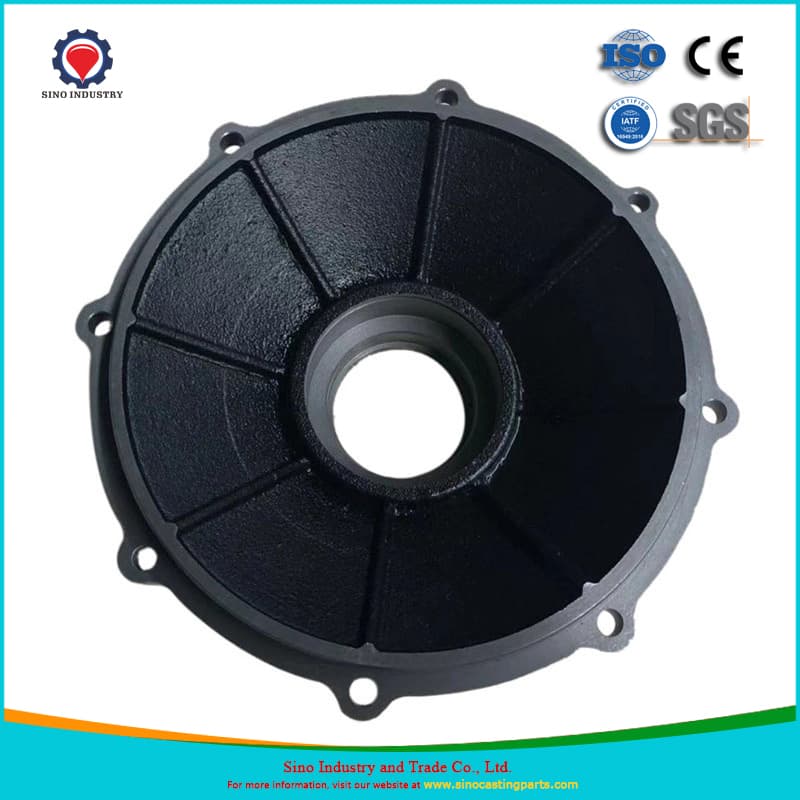
Not all gray iron shares the same properties. The ASTM A48 specification classifies gray iron based on minimum tensile strength. Truck engineers must match the correct class to the specific stresses the component will endure on the road. A mismatch here leads directly to field failures.
Class 20 to 30 grades provide exceptional machinability and thermal shock resistance. They contain a higher percentage of graphite flakes. These grades manage rapid heating and cooling cycles brilliantly. They are best suited for parts requiring heat dissipation and vibration absorption without facing high tensile loads. Exhaust manifolds and heavy-duty brake components fit this profile perfectly. Using higher grades for these parts unnecessarily complicates machining without adding functional value.
Conversely, Class 35 to 40 grades offer higher strength and superior wear resistance. They feature a tighter, more pearlitic matrix structure. You require these grades for structurally demanding gray iron cast components. Engine blocks, cylinder heads, and heavy-duty mounting brackets demand this extra rigidity. The trade-off is reduced machinability, requiring tougher tooling inserts on the assembly line.
Design considerations heavily influence how easily a component reaches the assembly line. Engineers must factor in wall thickness limitations early in the design phase. Thick sections cool slower than thin sections. This differential cooling creates internal stresses and shrinkage defects. Watch out for abrupt transitions between thick and thin walls. Always incorporate generous draft angles. These angles allow the foundry to remove the pattern from the sand mold without damaging the cavity. Preventing these defects at the design stage guarantees smoother assembly operations later.
ASTM A48 Gray Iron Classes and Truck Assembly Applications
Material Grade | Tensile Strength (psi) | Primary Strengths | Common Truck Applications |
|---|---|---|---|
Class 20 | 20,000 | Maximum machinability, thermal shock resistance | Non-structural covers, exhaust manifolds |
Class 30 | 30,000 | Balanced wear resistance and heat dissipation | Brake drums, brake rotors, pump housings |
Class 35 | 35,000 | High rigidity, good vibration damping | Transmission cases, heavy brackets |
Class 40 | 40,000 | Maximum wear resistance, highest strength | Diesel engine blocks, cylinder heads |
Truck manufacturers increasingly shift away from buying raw metal. Sourcing pre-machined turnkey components eliminates secondary operations at the OEM facility. This strategy transforms the assembly line. When parts arrive fully machined, plant managers can allocate floor space directly to vehicle assembly rather than maintaining heavy milling equipment.
Tight dimensional tolerance and refined surface finish directly dictate assembly speed. If a transmission housing mounting face exceeds flatness tolerances by even a few thousandths of an inch, the mating components will not seal. This bottleneck forces the line to stop. Assembly workers must either rework the part or discard it. Demanding strict geometric dimensioning and tolerancing (GD&T) from your supplier guarantees immediate fitment. Surface finish (often measured in Ra) also matters deeply for sealing surfaces. Gaskets fail prematurely if the cast surface remains too rough.
Defect mitigation must occur before delivery. Foundries should perform Non-Destructive Testing (NDT) at the machining stage. Machining raw castings often uncovers hidden subsurface porosity. Finding a void after you have milled a critical mounting hole wastes time and money. Ask your vendor to implement ultrasonic testing or magnetic particle inspection. These methods catch internal flaws before the component disrupts the truck assembly line. A proactive NDT protocol keeps defective parts out of your inbound logistics stream.
Truck components carry immense liability. A cracked brake drum or failed steering knuckle causes catastrophic accidents. Assembly plants must enforce rigorous quality control measures across their supplier network. Traceability and certification form the foundation of this risk management.
Every shipment requires full metallurgical certifications. Do not accept batches without Material Test Reports (MTRs). These reports prove strict adherence to ASTM A48 standards. They verify the chemical composition and the required tensile strength of the actual poured metal. If a part fails in the field, you must trace it back to a specific furnace heat.
Managing porosity and shrinkage requires direct communication with foundry engineers. You must ask specific questions about their gating and riser designs. The gating system controls how molten metal enters the mold. The riser feeds extra liquid metal into the casting as it cools and shrinks. A poorly designed riser system leads to internal structural voids. Demand fluid flow simulation reports. Modern foundries use software to model the pour and predict shrinkage locations before creating physical tooling.
Maintaining consistency across production runs separates capable suppliers from unreliable ones. High-volume truck manufacturing demands dimensional repeatability. Automated sand-casting lines, such as DISA lines, provide this critical consistency. Manual molding introduces human error. Automated lines pack the sand with exact, repeatable pressure. This prevents mold wall movement during the pour, ensuring every casting matches the original dimensional specifications precisely.
Demand chemical analysis via optical emission spectrometry for every heat.
Specify exact hardness testing locations on the component blueprint.
Require CMM (Coordinate Measuring Machine) reports for all critical machined dimensions.
Establish a clear containment plan if a defective batch reaches your dock.
Selecting the right foundry dictates the success of your procurement strategy. A mismatched supplier creates endless assembly headaches. Procurement teams must conduct thorough evaluations before awarding contracts for gray iron castings for truck parts.
Begin by verifying capacity and scalability. A foundry's available tonnage capacity must align with your projected annual truck production volumes. Do they have the furnace capacity to scale up if your vehicle orders surge? Ask for their current capacity utilization rate. A foundry running at 98% capacity has no room to absorb your emergency orders.
Prioritize vendors offering integrated capabilities. Sourcing raw castings from one vendor and shipping them to another facility for machining introduces massive logistics risks. If a part fails inspection, the machinist blames the foundry, and the foundry blames the machinist. Integrated partners handle in-house casting, machining, and surface finishing. This single-source responsibility reduces supply chain friction and accelerates resolution times when quality issues arise.
Execute a rigorous audit checklist during your site visit:
Review historical scrap rates: Ask to see their internal scrap data on similar heavy-duty truck components. Consistently high scrap rates indicate poor process control.
Request PPAP documentation: Review their Level 3 Production Part Approval Process packages. Examine their First Article Inspection (FAI) reports for completeness and accuracy.
Assess tooling maintenance programs: Sand rapidly wears down metal patterns. Ask how often they scan and repair their tooling. Worn patterns create oversized parts, ruining assembly tolerances.
Matching gray iron components to truck assembly needs requires a highly structured approach. You must specify the exact ASTM A48 material class based on the component's unique thermal and tensile requirements. Upgrading to pre-machined parts eliminates in-house secondary operations and keeps assembly lines moving without dimensional bottlenecks. Furthermore, strict supplier vetting ensures you partner with foundries capable of delivering consistent, high-volume quality.
Engineering and procurement teams should take immediate action. Audit your current casting reject rates to identify recurring porosity or tolerance issues. Initiate capability assessments (RFIs) with integrated foundry-machining partners to explore transitioning from raw materials to assembly-ready components. Prioritizing traceability, automated molding, and robust PPAP documentation will drastically reduce assembly downtime.
A: Focus on Class 30 or Class 35 gray iron for brake drums. These grades provide optimal thermal conductivity and excellent resistance to heat-checking. This specific balance ensures the component absorbs heavy vibrations while maintaining longevity under extreme, repeated braking loads.
A: Gray iron offers superior vibration damping due to its internal graphite flake structure. It absorbs heavy diesel engine vibrations much better than ductile iron. Additionally, its natural lubricity drastically improves ease of machining, which remains critical for manufacturing efficiency on complex block geometries.
A: Receiving pre-machined castings completely eliminates your internal machining overhead. It minimizes scrap handling on your factory floor and streamlines inbound logistics. When parts arrive assembly-ready, operators can immediately install them, avoiding dimensional bottlenecks and maximizing production line throughput.
A: A reliable Tier-1 supplier must provide comprehensive metallurgical certifications. Essential documents include Material Test Reports (MTRs) verifying chemical composition, detailed dimensional inspection reports (CMM data), and complete Level 3 PPAP packages to prove consistent, repeatable manufacturing processes.


