
Views: 0 Author: Site Editor Publish Time: 2026-08-17 Origin: Site


Engineers and procurement teams constantly face a critical balancing act in modern manufacturing. You must weigh component strength against overall weight and strict production budgets. Material selection errors easily lead to catastrophic mechanical failures or heavily bloated expenses. We see Ductile Iron Casting as the primary alternative to heavy steel forgings and brittle gray iron. It successfully bridges the gap between high malleability and exceptional tensile strength.
This unique material transforms how industries design heavy-duty parts. It offers incredible versatility for diverse engineering challenges. This guide serves as your objective baseline for evaluating material specifications. You will learn how to navigate complex metallurgical grading systems accurately. By the end, you will confidently align component requirements with exact foundry capabilities. We also provide actionable steps to vet potential foundry partners for consistent, defect-free production.
Structural Superiority: The nodular graphite microstructure of ductile iron offers a superior strength-to-weight ratio and higher impact resistance compared to gray iron.
Grade Specification is Application-Dependent: Selecting the correct ASTM/ISO grade (e.g., Ferritic vs. Pearlitic) strictly dictates the balance between machinability, yield strength, and elongation.
Process Control Mitigates Risk: Consistent mechanical properties rely heavily on modern foundry controls, specifically in melting techniques, nodularization, and inoculation.
Sourcing Demands Rigor: Shortlisting a foundry requires verifying in-house metallurgical testing capabilities, NDT (Non-Destructive Testing) standards, and quality certifications.
Many manufacturing businesses struggle with rising operational expenses and failing parts. You might encounter exceptionally high machining costs when relying exclusively on steel forgings. Alternatively, you might face premature fatigue failure in older, legacy gray iron components. Heavy machinery manufacturers also constantly seek reliable ways to lightweight their bulky equipment designs. These common industrial drivers force engineering teams to thoroughly re-evaluate their baseline material choices.
How does this material actually work under stress? The metallurgical mechanism is quite fascinating. Foundries introduce a precise magnesium treatment during the active molten phase. This specific chemical treatment transforms the sharp, jagged graphite flakes found in gray iron into round graphite nodules. These tiny internal spheres effectively arrest microscopic crack propagation. Consequently, the metal flexes and absorbs energy rather than snapping instantly under intense pressure.
Production realities heavily favor this nodular structure when evaluated objectively. You must compare initial tooling, casting processes, and subsequent machining expenses against carbon steel and aluminum alternatives. We assume tooling costs often mirror standard gray iron molding processes. However, the per-part cost drops significantly during post-production. You offset initial capital expenses through vastly reduced machining time. Weight savings compared to bulky steel also lower your shipping and handling fees. You avoid the excessive raw material waste typically associated with heavy forging operations.
Tensile and yield strengths define exactly how much load a part handles before failing. Realistic yield strength ranges fall broadly between 40,000 psi and 100,000 psi depending on the grade. You must match these yield strength requirements directly to your dynamic load expectations. Over-specifying strength adds unnecessary production costs and actively reduces machinability. Engineers often select a medium-strength grade for general structural frames. This strategy ensures excellent safety margins without creating severe CNC production bottlenecks.
Ductility refers to a metal's physical ability to stretch without breaking. Elongation percentages measure this vital property before structural fracture occurs. You always want materials to deform visibly under tension before catastrophic failure. This provides a highly critical safety factor for automotive suspension arms and bridge structural supports. Visual deformation alerts your field inspectors to excessive stress long before the part shatters completely.
Post-casting machining frequently consumes large portions of manufacturing budgets. Fortunately, the embedded spherical graphite acts as a natural, solid lubricant. This inherent internal lubrication actively reduces tool wear during aggressive CNC milling or turning operations. Operators can run automated machines at significantly higher speeds. You achieve smoother surface finishes while drastically extending the life of your expensive cutting tools. Furthermore, the material hardens nicely, providing excellent wear resistance for high-friction applications.
Industrial machine tools and massive engines generate severe mechanical vibrations. You need heavy structural components capable of absorbing these disruptive energy waves. This specific material dampens vibration much better than standard carbon steel components. However, it remains slightly inferior to traditional gray iron in pure, raw damping capacity. Seasoned engineers readily accept this minor tradeoff. You gain significantly higher tensile strength while still retaining highly adequate noise and vibration control.
Global metallurgical standards provide a universal communication language for engineers and foundries. Understanding standard nomenclature is essential for accurate procurement. For instance, the common American grade 65-45-12 conveys specific mechanical minimums. It represents 65,000 psi tensile strength, 45,000 psi yield strength, and a 12% elongation rate. You specify these exact numbers to guarantee consistent part performance under extreme mechanical stress.
Ferritic grades possess a primarily ferrite matrix surrounding the internal graphite nodules. They undergo controlled cooling to maximize this specific microscopic structure.
Best for: These grades offer maximum ductility and truly excellent machinability. They also provide exceptional low-temperature impact resistance.
Applications: You will commonly find them in heavy-duty pressure valves, high-pressure pipe fittings, and automotive steering knuckles. They perform beautifully where parts might face sudden physical impacts in freezing outdoor environments.
Pearlitic grades contain a noticeably higher percentage of pearlite within the metal matrix. They trade some flexibility to achieve superior rigidity.
Best for: They provide extremely high strength and support heavy, abrasive wear applications. You sacrifice moderate ductility to secure this robust performance.
Applications: Heavy industries rely heavily on these grades for internal combustion gears, heavy-duty crankshafts, and massive earth-moving machinery. They resist surface wear brilliantly under continuous, grinding friction.
Some engineering projects demand the absolute ultimate performance limits. We position Austempered Ductile Iron (ADI) as a highly specialized, heat-treated upgrade. You specify ADI when components require forged steel-like strength. It beautifully retains the distinct economic and design advantages of near-net-shape casting. ADI parts rival forged carbon steel in fatigue strength but typically weigh nearly 10% less.
Standard Material Properties Comparison
ASTM A536 Grade | Tensile Strength (psi) | Yield Strength (psi) | Elongation (%) | Primary Matrix |
|---|---|---|---|---|
60-40-18 | 60,000 | 40,000 | 18 | Ferritic |
65-45-12 | 65,000 | 45,000 | 12 | Ferritic / Pearlitic |
80-55-06 | 80,000 | 55,000 | 6 | Pearlitic / Ferritic |
100-70-03 | 100,000 | 70,000 | 3 | Pearlitic |
120-90-02 | 120,000 | 90,000 | 2 | Tempered Martensite |
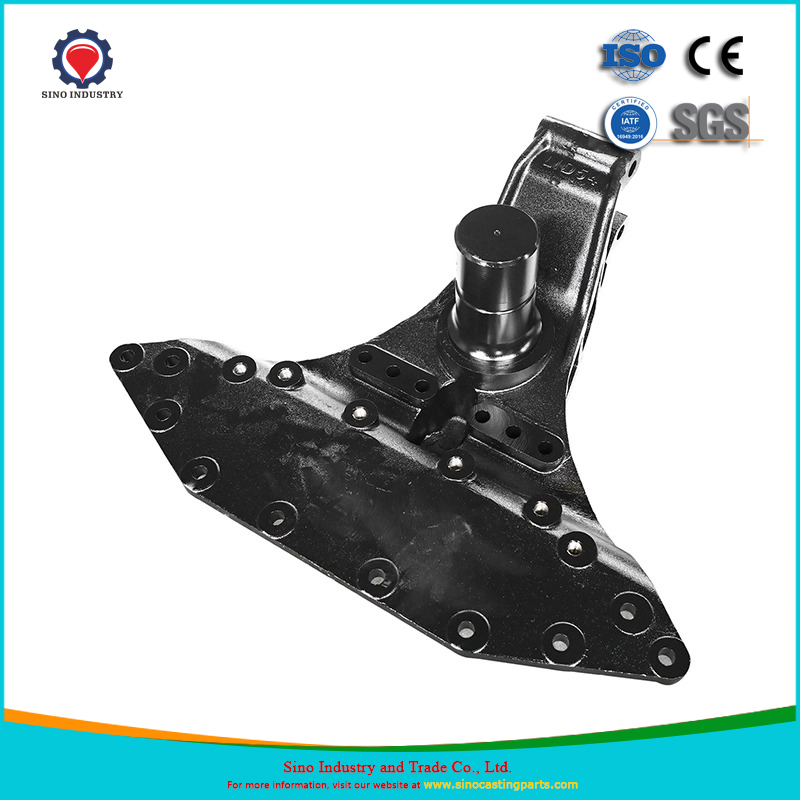
The manufacturing journey begins deep inside the primary furnace. Modern foundries typically utilize sophisticated electric induction furnaces or traditional cupola melting techniques. These methods directly impact the core purity of the base iron. Technicians must tightly control the exact carbon and silicon equivalents before pouring. Slight deviations in heating temperature or base chemistry ruin nodularity completely. Poor melting practices ultimately create weak, brittle parts that fail unexpectedly.
Inoculation provides the vital chemical "seeds" for graphite nodules to grow properly. Operators add specific ferrosilicon alloys just before pouring the molten metal into molds. You must understand the strict necessity of precise inoculation fading times. The chemical inoculant loses its effectiveness rapidly over just a few short minutes. If poorly managed, the casting risks massive internal carbide formation. This flaw results in extreme brittleness and guarantees catastrophic part failure in the field.
Physical trial and error wastes immense amounts of capital and time. Leading manufacturing facilities rely heavily on modern solidification simulation software. Programs like MAGMASOFT simulate the exact pouring and thermal cooling phases digitally. Process engineers predict dangerous shrinkage, microporosity, and internal thermal stress visually. They adjust complicated gating and riser designs in the software before a physical mold is ever poured. This advanced technology drastically reduces expensive scrap rates.
Reputable foundries do not rely solely on late-stage post-production inspection. Catching internal defects after parts cool wastes valuable time and raw resources. Quality is embedded proactively through real-time thermal analysis on the floor. Technicians utilize advanced optical spectrometry directly on the active pour line. They adjust chemical compositions dynamically before the metal ever enters the sand molds. You receive reliable Ductile Iron Castings that meet exact specifications on the very first run.
Choosing the right manufacturing partner actively mitigates severe supply chain risks. You must evaluate potential foundries using a rigid, highly objective framework. Use the following logical criteria to shortlist your most capable vendors.
Verify In-House Testing Capabilities: A credible foundry cannot outsource basic metallurgical quality control. They must possess on-site optical emission spectroscopy tools. They absolutely need digital hardness testing equipment and metallography labs for microstructure analysis. This infrastructure ensures they confidently prove grade compliance per batch before shipping any parts.
Mandate Non-Destructive Testing (NDT): Basic visual surface inspections frequently miss dangerous internal voids. You must mandate that vendors offer rigorous NDT services. Demand ultrasonic testing, magnetic particle inspection, or industrial X-ray capabilities. These specific tests are undeniably vital for critical, high-liability components like crane hooks or commercial suspension parts.
Check Certifications and Traceability: A simple handshake guarantees nothing in modern global manufacturing. Frame ISO 9001 or automotive-grade IATF 16949 as absolute non-negotiable baselines. Look deeply into their daily documentation practices. You want serialized batch traceability for every order. They should digitally track the entire process from the raw scrap melt to the final shipped casting.
Evaluate Prototyping to Production Scalability: Rapid product development requires immense manufacturing flexibility. Evaluate the foundry's operational capacity to handle low-volume prototyping for your initial design validation. Concurrently, assess their high-volume automated matchplate lines or modern flaskless molding equipment. They must seamlessly scale their physical output as your market demand grows.
Long-term success relies entirely on matching the right metallurgical grade to your specific application. You secure this success by partnering exclusively with a foundry that exercises strict, modern metallurgical control. Leverage the superior strength-to-weight ratio and near-net-shape advantages to dominate your market. As a next step, we strongly encourage engineering teams to collaborate early. Bring your 3D CAD models, dynamic load requirements, and current material pain points to a certified foundry. Request a comprehensive manufacturability review to uncover immediate design improvements and cost efficiencies.
A: Generally yes. Near-net-shape casting drastically reduces raw material waste. It also results in significantly lower machining times compared to forged steel. You must amortize initial tooling costs over your total production volume. However, the per-part savings quickly offset these upfront expenses for medium to high-volume runs.
A: It is technically possible but highly difficult. We generally do not recommend welding for critical structural joints. The intense heat creates a high risk of localized cracking. You also experience a severe loss of ductility in the heat-affected zone. Engineers should design components to avoid secondary welding whenever possible.
A: You should expect a realistic timeframe of 6 to 12 weeks. This period covers initial mold tooling creation and the First Article Inspection (FAI). Complex geometries or heavy foundry backlogs can extend this window slightly. Once the FAI is approved, high-volume production runs typically process much faster.
A: ADI undergoes a highly controlled isothermal heat treatment process. This specific thermal cycle completely transforms the microstructure. The resulting material is twice as strong as standard ductile grades. It maintains excellent fatigue strength and wear resistance. You gain the robust performance of forged steel while keeping the economic benefits of casting.


