
Views: 0 Author: Site Editor Publish Time: 2026-10-05 Origin: Site


Industrial machinery faces brutal operating conditions daily. It requires rugged enclosures to survive. These housings protect sensitive internal components. They block aggressive environmental contaminants. They endure extreme thermal stress constantly. They also withstand severe operational vibration. Over-engineering these enclosures inflates production costs rapidly. Engineers often mistakenly specify expensive specialized alloys. Conversely, under-engineering leads to catastrophic equipment failure. It causes expensive downtime on the factory floor. For bulk structural enclosures, iron remains the ultimate standard. You will learn exactly where engineers deploy these housings. We will explore how to evaluate alternative materials effectively. You will also discover strict criteria for shortlisting a foundry. This ensures reliable production runs for your team.
Vibration Control: The graphite flake microstructure of gray iron offers superior vibration damping compared to steel or aluminum, extending the lifespan of enclosed gears and bearings.
Cost-Efficient Complexity: Casting allows for complex internal geometries (cooling jackets, fluid channels) at a lower total cost of ownership than fabricated or heavily machined alternatives.
Primary Use Cases: Dominant in gearbox enclosures, pump housings, compressor shells, and machine tool bases.
Supplier Cruciality: Successful deployment requires strict metallurgical control to prevent porosity and ensure dimensional stability during post-processing.
Engineers globally trust Gray Iron Castings for heavy machinery. The material offers a unique graphite flake microstructure. These continuous graphite flakes act as internal shock absorbers. They absorb kinetic energy efficiently. They dissipate this energy before it causes structural damage. This structural reality minimizes harmful resonance. It reduces acoustic noise in heavy equipment significantly. Steel cannot match this damping capacity. Aluminum falls short too. Gray iron naturally deadens vibration across all frequencies.
Thermal stability represents another massive advantage. Gray iron handles rapid thermal cycling beautifully. It resists warping under high heat. Many housing components generate localized heat. Motors and friction brakes produce intense temperatures. The casting absorbs and spreads this thermal load evenly. It maintains dimensional integrity under heavy stress. You avoid housing distortion during peak operation.
We must also consider machinability and economics. The graphite flakes provide natural internal lubrication. This produces short, brittle chips during milling operations. Short chips clear out of cutting paths easily. They reduce friction on drill bits. They lower tool wear significantly. You spend less money on replacement cutting tools. Final surface finishing becomes highly efficient. The cost-to-weight ratio remains unbeatable for large enclosures. Production economics heavily favor this approach for heavy industrial applications.
Industrial designers deploy gray iron machinery housings across demanding sectors. These applications share a need for rigidity. They demand strict acoustic control. They require complex internal shapes.
Gearboxes require rigid shaft alignment. They also need serious acoustic dampening. Under heavy torque, gears try to separate forcibly. Gray iron prevents micro-shifting of gears under load. It holds internal bearings in perfect alignment. This reduces physical wear on the gear teeth. It also muffles audible gear whine. The heavy mass traps noise inside the box. Operators experience a safer, quieter working environment.
Pumps demand reliable pressure retention. They need basic corrosion resistance. Cast iron delivers both properties efficiently. Engineers design complex volutes for optimal fluid flow. Casting allows seamless internal flow paths. You avoid welding separate pieces together. Welded joints often fail under high pressure. Cast shells offer a unified, pressure-tight barrier. They handle industrial fluids reliably.
Machine tools need extreme structural rigidity. They require maximum vibration absorption. High mass prevents tool chatter during cutting operations. Gray iron damping properties stabilize the entire machine. This ensures high-precision machining tolerances. When cutting tools hit hard metal, vibrations travel downward. The heavy iron base absorbs these shocks. It keeps the cutting tip perfectly steady.
Electric motors need structural protection. They also demand excellent heat transfer. Foundries cast cooling fins directly into the frame. This maximizes exterior surface area for heat dissipation. The rugged shell protects the stator. It defends internal coils from accidental industrial impact. Forklifts and heavy tools frequently bump factory equipment. The cast frame absorbs these blows harmlessly.
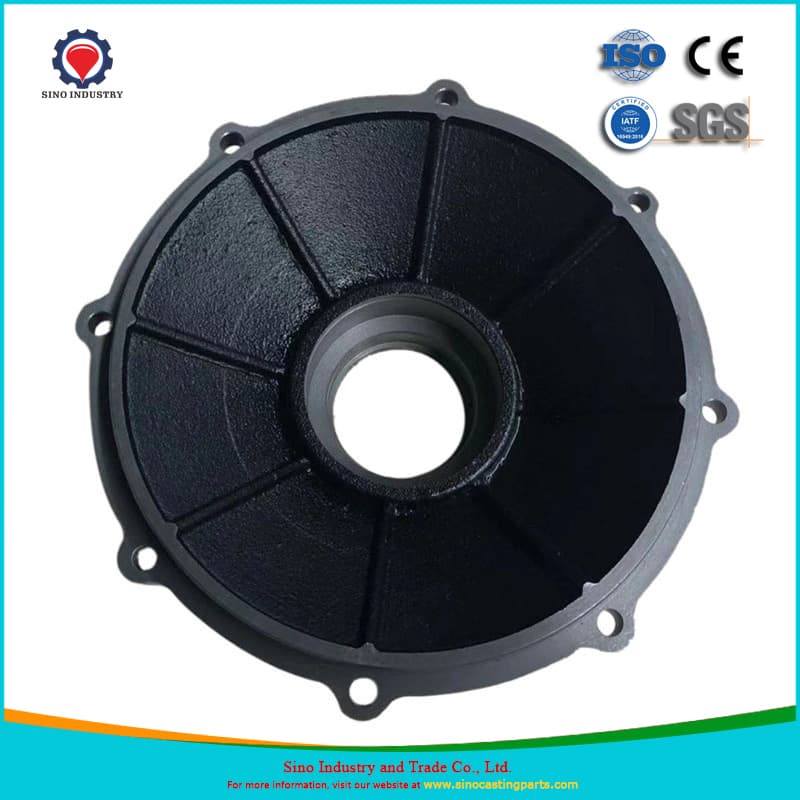
Engineers often compare materials before finalizing blueprints. You must evaluate gray iron cast components against alternatives carefully. Making the wrong choice compromises machine performance.
These two materials look identical visually. They perform very differently structurally. Ductile iron offers higher tensile strength. It provides better impact resistance. However, it sacrifices roughly half the vibration-damping capacity. The graphite forms into distinct spheres inside ductile iron. It does not form continuous flakes. This reduces its ability to absorb kinetic energy.
Follow a simple decision rule here. Use gray iron for static, continuous-load housings. Upgrade to ductile iron only when absolutely necessary. Use it if the housing faces sudden, severe physical impacts.
Steel fabrication works well for low-volume production. It suits simple square boxes. However, welded steel amplifies machine vibration. It acts exactly like a tuning fork. It rings and shakes under heavy load. Furthermore, machining complex internal geometries into steel costs a fortune. It requires intense labor and expensive custom tooling.
At medium-to-high volumes, casting becomes superior. It dramatically lowers per-unit manufacturing costs. You pour the complex shape once. You avoid dozens of expensive welding hours.
Material Performance Comparison
Material Type | Vibration Damping | Tensile Strength | Complex Geometry Cost |
|---|---|---|---|
Class 30 Gray Iron | Excellent | Moderate | Low |
Ductile Iron | Moderate | High | Low |
Fabricated Steel | Poor | Very High | High |
Procurement teams face distinct implementation realities. Sourcing machined gray iron castings carries specific manufacturing risks. You must identify and control these variables early.
Poor foundry gating causes hidden internal voids. Inadequate risering leads to shrinkage during cooling. These hidden defects compromise structural integrity entirely. They cause fluid leaks in pressure-retaining housings. You must demand strict quality control protocols. Require Non-Destructive Testing (NDT) from your supplier. Specify ultrasonic scanning or X-ray inspection. These methods reveal internal porosity before machining begins.
Cooling rates dictate overall material hardness. Thin walls cool rapidly. Thick walls cool slowly. Variations in housing design cause inconsistent cooling. This creates localized hard spots called chill. Chill destroys expensive cutting tools during CNC machining. It halts production lines unexpectedly. Ensure your foundry controls cooling rates meticulously. They must balance the metallurgical matrix perfectly.
Sand cores form internal cavities. These cores can shift during the pouring process. Core shift ruins dimensional tolerances completely. Wall thicknesses become uneven. The casting becomes useless scrap. Highlight the necessity of advanced foundry equipment. Look for automated molding lines. Demand precise 3D-printed sand cores for complex internal housings. These advanced technologies lock cores firmly in place.
Selecting the right manufacturing partner ensures project success. You need a foundry capable of repeatable precision. Use specific criteria to evaluate potential suppliers thoroughly.
Verify Metallurgical Consistency: Require documented compliance with industry standards. ASTM A48 Class 30 or Class 35 remain standard choices. Ask for historical material test reports (MTRs). These reports prove consistent tensile and hardness metrics across production batches.
Assess In-House Machining Capabilities: Look for foundries offering turnkey solutions. Splitting casting and machining between two vendors introduces massive risk. It often leads to finger-pointing. When dimensional defects emerge during milling, both vendors blame each other. Keep responsibility under one roof.
Evaluate Flask Size and Tonnage Limits: Check the foundry equipment specifications. Ensure their automated or floor-molding lines match your housing. The physical envelope and weight must fit their sweet spot. Pushing a foundry beyond its normal limits causes severe quality issues.
Initiate a Design for Manufacturability (DFM) review immediately. A credible supplier analyzes your CAD files thoroughly. They suggest optimized draft angles. They recommend uniform wall thicknesses. They identify the best parting lines. Early foundry involvement streamlines the entire process. It lowers casting production costs substantially.
Gray iron machinery housings remain unmatched in industrial applications. They sit at the perfect intersection of critical engineering requirements. They offer incredible vibration damping. They provide reliable thermal stability. They deliver cost-effective geometric complexity. Alternative materials struggle to balance these three vital factors.
Take action on your next enclosure project today. Prompt your engineering or procurement team directly. Submit your housing blueprints for a technical DFM review. Emphasize early foundry involvement to your stakeholders. This proactive step prevents costly design revisions later. It ensures total machining predictability. It guarantees your machinery operates reliably in the harsh field.
A: Engineers typically specify ASTM A48 Class 30 or Class 35. These grades offer the best balance of machinability and tensile strength. Class 30 provides excellent vibration damping for general machinery enclosures. Class 35 delivers slightly higher strength for more demanding structural applications. Both grades machine easily and resist thermal warping.
A: It is technically possible but highly risky. Welding cast iron requires extensive pre-heating to prevent cracking. You must use specialized nickel rods. It alters the localized metallurgical structure, creating brittle zones. Experts strongly discourage structural welding on iron housings. Redesigning and pouring a new casting is always the safer choice.
A: Wall thickness directly controls the cooling rate during production. Thin walls cool too fast, forming brittle structures. Excessively thick walls cool too slowly, reducing overall material strength. Maintaining uniform thickness across the housing is key. It ensures a consistent metallurgical matrix, prevents hard spots, and optimizes final machining.


