
Views: 0 Author: Site Editor Publish Time: 2026-08-24 Origin: Site


Selecting the proper casting material dictates the ultimate success of heavy-duty engineering projects. Engineers constantly face complex metallurgical choices when designing critical industrial components. Every project demands rigorous attention to physical capabilities. Selecting the correct casting material requires balancing mechanical performance, long-term endurance, and practical manufacturability. You must weigh the superior tensile strength and impact resistance of ductile iron against the unmatched vibration damping and lower initial cost of gray iron. Making the wrong choice inevitably leads to catastrophic part failures or unnecessary manufacturing expenses. This guide evaluates both materials across metallurgical, mechanical, machining, and procurement dimensions to support final specification decisions. We will explore underlying physical properties, real-world industrial applications, and global sourcing standards. You will walk away knowing exactly which material perfectly fits your specific engineering requirements.
The fundamental difference lies in graphite microstructure: flake graphite (gray iron) causes brittleness but dampens vibration, while spherical graphite (ductile iron) enables flexibility and high tensile strength.
Gray iron is optimal for stationary load-bearing and vibration-heavy applications (e.g., machine bases, engine blocks).
Ductile iron casting is required for high-stress, impact-prone components (e.g., suspension parts, pressure valves).
Carbon precipitates during the metal casting process as the molten iron cools. The metal solidifies and traps this carbon inside the iron matrix. The exact shape of these carbon deposits determines the final physical properties of the component. We control this shape through specific cooling rates and chemical additives. The base iron mixture looks very similar initially. However, the final microscopic structure dictates how the metal behaves under physical stress.
Graphite forms into irregular flakes inside standard gray iron. You can see these distinct flake patterns under a microscope. These flakes disrupt the continuity of the iron matrix. They act as significant stress concentrators across the material. This creates natural fracture points throughout the metal body. Consequently, gray iron exhibits significantly lower tensile strength. It tends to crack or break when subjected to sudden impacts.
Foundries change this metallurgical behavior through strict chemical control. We introduce magnesium into the molten iron before pouring. This magnesium treatment forces the graphite to form microscopic spheres. Metallurgists call these spheres nodules. The spherical shape eliminates the sharp fracture lines found in gray iron. This fundamentally changes the mechanical behavior of the iron. The metal gains incredible flexibility and high resistance to impact forces.
Strength metrics heavily favor nodular iron alloys. Gray iron typically offers a tensile strength between 20,000 and 40,000 PSI (138-276 MPa). It lacks a measurable yield strength because it fractures before bending. Conversely, typical grades of Ductile Iron Casting offer tensile strengths ranging from 60,000 to over 100,000 PSI (414-689 MPa). The spherical graphite prevents microscopic cracks from spreading. This allows ductile iron parts to consistently handle heavy dynamic loads without structural failure.
Ductility measures a material's ability to bend before breaking. Gray iron possesses essentially zero elongation. It fractures immediately under extreme stress. Ductile iron behaves much more like mild steel. It routinely achieves elongation percentages between 3% and 18%. You can physically deform a ductile iron component under heavy loads. It will stretch and bend rather than shatter.
Gray iron remains the undisputed industry standard for absorbing vibrations. The graphite flakes effectively absorb and dissipate sound waves and mechanical vibrations. Spherical graphite cannot absorb these energies as efficiently. Machine builders rely on gray iron for CNC machine beds. They also use it for heavy equipment housings. The material dampens tool chatter and operational noise brilliantly.
Thermal cycling demands specific material properties. Gray iron handles rapid heating and cooling exceptionally well. The graphite flakes conduct heat rapidly away from friction sources. This makes gray iron ideal for automotive brake rotors. Both materials offer excellent wear resistance under friction. The graphite acts as a natural solid lubricant in both alloys.
Table 1: Mechanical Property Comparison Chart
Property | Gray Iron | Ductile Iron |
|---|---|---|
Graphite Shape | Flake | Spherical (Nodular) |
Tensile Strength | Low (20k - 40k PSI) | High (60k - 100k+ PSI) |
Elongation (Ductility) | 0% (Brittle) | 3% - 18% (Flexible) |
Vibration Damping | Excellent | Low to Moderate |
Impact Resistance | Poor | Excellent |
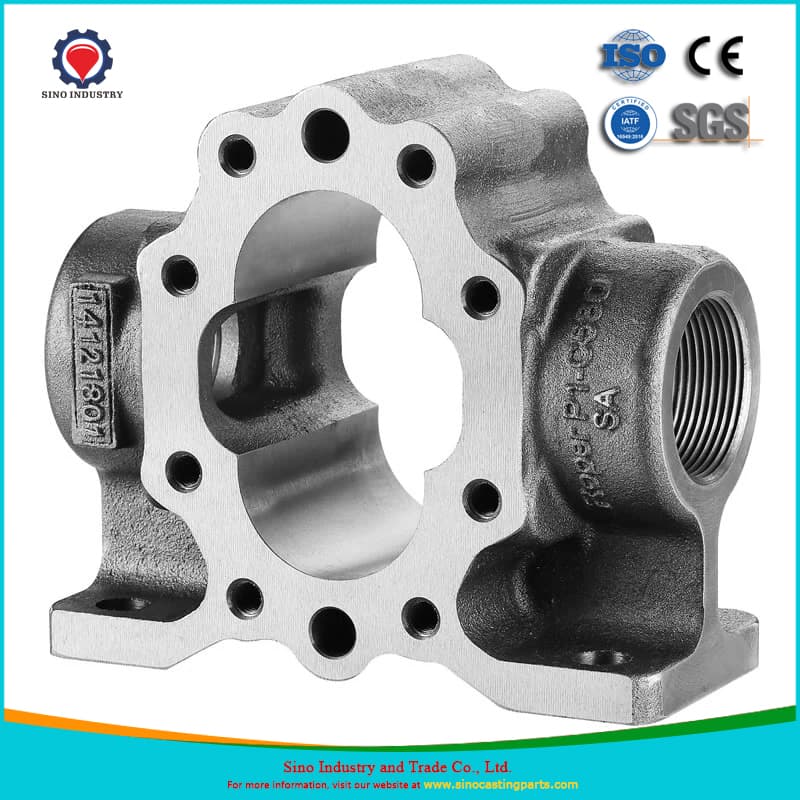
Shop-floor realities often dictate material choices. Gray iron is highly machinable. The graphite flakes allow cutting tools to slice through the metal easily. Machinists can run higher feeds and speeds safely. Tool wear remains relatively low. Conversely, machining Ductile Iron Casting requires slower surface speeds. You need tougher carbide tooling to handle the increased material strength. The higher strength naturally generates more heat at the cutting edge.
CNC operators monitor chip formation constantly. Gray iron produces granular, fragmented chips. These small chips clear away from the cutting zone effortlessly. They rarely tangle around the tooling. Ductile iron produces continuous, stringy chips. These long chips can wrap around tool holders or workpieces. Proper chip management becomes critical. Machinists must utilize peck drilling cycles and specialized chip-breaking inserts.
Achieving a smooth surface finish differs between the two materials. Gray iron often leaves a slightly porous microscopic surface. The flakes tear away during heavy cuts. You can achieve good finishes, but the baseline appearance is matte. Ductile iron finishes much more like steel. It yields a smooth, shiny surface post-machining. You can polish ductile iron to a highly refined finish.
Buyers must establish a framework for weighing production expenses. Gray iron offers lower initial casting and machining costs. The raw materials cost less. The machining cycles run faster. However, specifying ductile iron prevents catastrophic failures in heavy-duty applications. You must avoid over-engineering costs. Do not specify ductile iron where it is not strictly necessary. Match the material cost directly to the operational demands.
Certain applications perfectly match gray iron properties. You should choose this material for environments requiring stability and vibration control.
Stationary housings and machine bases: The damping capacity prevents vibration damage to sensitive internal components.
Pump components and gearboxes: Complex internal geometries cast easily, and the rigid walls maintain dimensional stability.
Automotive brake components: Thermal dissipation properties prevent brake fade during rapid deceleration.
Municipal applications: Manhole covers utilize gray iron because impact resistance is secondary to raw material cost.
High-stress environments demand structural flexibility and immense strength. You must specify spherical graphite iron for dynamic load applications.
Automotive and heavy truck components: Suspension systems and steering knuckles endure constant road impacts.
Infrastructure: Underground water and pressure pipes must bend slightly as the earth settles.
Heavy equipment: Agricultural and construction equipment linkages handle massive twisting forces daily.
Valves and fluid control: High-pressure hydraulic bodies require absolute structural integrity against bursting.
Global sourcing requires a clear reference structure. Engineers and buyers must navigate different international standards carefully. A specific grade in the United States has direct equivalents in Europe and Germany. Understanding these maps prevents costly procurement errors. You must ensure your foundry understands the exact mechanical requirements.
Table 2: Global Material Standard Equivalents
Material Type | USA (ASTM) | Europe (EN) | Germany (DIN) |
|---|---|---|---|
Gray Iron | ASTM A48 | EN 1561 | DIN 1691 |
Ductile Iron | ASTM A536 | EN 1563 | DIN 1693 |
In the USA, engineers widely use ASTM A48 Class 30 or Class 40. Class 30 denotes 30,000 PSI tensile strength. The European equivalent falls under EN 1561 as EN-GJL-200. In Germany, engineers historically specified DIN 1691 GG20. These grades offer identical physical properties. They all guarantee specific tensile strengths for standard machinery parts.
When sourcing Ductile Iron Casting, ASTM A536 Grade 65-45-12 is heavily utilized. This indicates 65,000 PSI tensile strength, 45,000 PSI yield, and 12% elongation. In Europe, the EN 1563 standard classifies this as EN-GJS-450-10. German engineers recognize this under DIN 1693 as GGG40. These specific grades represent the most common workhorse materials for heavy industry.
Sourcing from new foundry partners introduces metallurgical risk. You must require material test reports (MTRs) for every production batch. You should demand nodularity certifications when purchasing ductile parts. A failed magnesium treatment leaves you with brittle metal. Verify these reports rigorously before accepting any shipment. Consistent testing prevents catastrophic failures in the field.
Engineers often need to identify existing legacy parts during teardowns. The acoustic resonance test provides immediate feedback. Strike the component firmly with a basic steel hammer. Gray iron produces a short, dull thud. The internal graphite flakes deaden the sound waves instantly. Striking ductile iron produces a clear, lingering, bell-like ring. The spherical matrix allows the sound waves to travel freely.
Examining a broken component reveals its exact metallurgical makeup. Look closely at the fractured surface. Gray iron fractures appear dull, dark gray, and highly crystalline. You will see a rough, grainy texture. Ductile iron fractures look completely different. The broken surface appears brighter. It resembles broken steel, featuring a silver-like, jagged edge where the metal tore apart.
Field excavations frequently uncover unidentified pipes or housings. Both materials oxidize, but they rust differently. Gray iron tends to develop a deeper, flaking rust over decades. The rust penetrates through the flake network. Ductile iron oxidizes primarily on the surface. It develops a tighter, more uniform protective patina. Check the casting dates. Most foundries rarely poured ductile pipes before the late 1950s.
Choosing the correct casting material requires understanding your mechanical baseline. The decision framework relies heavily on your operational environment.
Choose gray iron strictly for vibration damping, thermal cycling applications, and straightforward cost-efficiency.
Select ductile iron for extreme tensile strength, impact resistance, and dynamic load-bearing scenarios.
Never over-engineer your parts; use ductile metal only when the stress requirements mandate it.
Always demand verified material test reports from your international suppliers.
Your next step requires proactive communication. We strongly encourage evaluators to consult a trusted foundry partner early in the design phase. Align your final material specifications directly to your tooling capacities, machining capabilities, and end-use environments.
A: Yes, but the process is highly difficult. Both cast irons possess high carbon content, making them extremely susceptible to cracking during cooling. You must apply intense pre-heating before welding. You also need specialized nickel-based filler rods. Ductile iron is slightly more weldable than gray iron, but it still requires a highly skilled operator and strict temperature controls.
A: No. The primary metallurgical boundary lies in the carbon content. Steel contains less than 2% carbon. Cast irons, including ductile, contain between 2% and 4% carbon. While ductile metal shares many mechanical properties with steel (like flexibility and strength), it remains firmly classified as cast iron.
A: Generally, no. You usually need pattern modifications. Ductile iron has a different shrinkage rate than gray iron during the solidification process. It also requires much larger risers to feed the casting properly. Pouring ductile metal into a mold designed for gray iron often results in severe shrinkage defects.
A: The manufacturing process demands stricter controls. Foundries must purchase expensive nodularizing agents like magnesium. We must precisely monitor the pouring temperatures and chemical timing. Additionally, ductile metal requires more energy to melt and longer time to machine, all of which elevate the final component price.


