
Views: 0 Author: Site Editor Publish Time: 2026-10-29 Origin: Site


Buyers face a tough dilemma when sourcing complex components. 5-axis CNC machining offers unparalleled precision and reduced setup times. However, it comes at a higher hourly rate than traditional 3-axis milling. You must decide if this premium adds genuine value. The decision is not a purely technical upgrade. It requires a solid business case. You must balance part complexity, production volume, and the total cost of quality (COQ). Evaluating your specific component requirements determines the best path forward. You might start from raw billets or near-net-shape castings. This evaluation reveals if premium Machining Services are a strict requirement or an unnecessary expense. You will learn how to identify parts needing true multi-axis work. Finally, we will cover how to vet potential manufacturing partners effectively.
Simultaneous 5-axis machining is mandatory for continuous compound curves (e.g., impellers, turbine blades) but often overkill for flat, prismatic parts.
Positional 5-axis (3+2 machining) bridges the gap, offering reduced fixturing setups for multi-sided industrial equipment components without the simultaneous 5-axis price tag.
Integrating CNC machining for cast parts and machining forged metal parts heavily benefits from multi-axis capabilities to handle uneven datum points and complex secondary finishing.
Choosing the right service provider requires evaluating their machine rigidity, thermal stability controls, and inspection capabilities—not just axis count.
Manufacturing leaders must address the total cost of manufacturing. You cannot look at machine rates in a vacuum. You must compare the higher hourly rate of 5-axis machines against the hidden costs of 3-axis setups. Traditional 3-axis methods often require multiple fixtures. They demand constant operator intervention. Every time an operator moves a part, you introduce tolerance stacking. These hidden expenses quickly erode profit margins.
You can justify the premium rate when specific success criteria apply. Consider the investment validated when:
Setup time reduction exceeds the hourly rate delta. If a part needs six different 3-axis operations, consolidating them saves hours of labor. This savings outweighs the higher machine cost.
Scrap rates become commercially unacceptable. Manual re-fixturing causes tolerance stacking. If this stacking ruins expensive raw materials, you need a more controlled process.
Lead times require drastic compression. Consolidating operations enables "Done-in-One" machining. This approach pushes parts through production much faster.
We must also maintain a healthy skepticism. For simple, single-plane parts, moving to 5-axis will increase costs. It will not deliver proportional value. Prismatic parts feature flat, straightforward profiles. You should keep these on reliable 3-axis centers. Upgrading them merely wastes capital. You must reserve multi-axis capabilities for geometries genuinely demanding them.
Engineers must differentiate between components requiring simultaneous 5-axis interpolation and those merely benefiting from it. Simultaneous movement means all five axes move concurrently. The cutting tool dances around the workpiece continuously. Let us break down the physical geometries demanding this premium solution.
Certain components feature sweeping, contoured surfaces. The cutting tool must maintain continuous perpendicularity to these surfaces. Without this constant angle, the tool leaves gouges or step marks. You cannot achieve optimal fluid dynamics using stepped toolpaths.
Centrifugal compressors and turbine blades represent perfect examples. Aerospace monolithic structures also fall into this category. The airflows running across these surfaces require flawless transitions. Any minor surface deviation causes catastrophic drag or turbulence. Therefore, simultaneous 5-axis interpolation becomes a mandatory technical requirement.
Engineers regularly design components featuring deep pockets or steep walls. CNC machining for industrial equipment parts often involves these challenging profiles. Hydraulic manifolds and mold cavities present distinct accessibility issues.
5-axis machines provide a distinct advantage here. The spindle head can tilt away from the workpiece. This tilt allows machinists to use much shorter cutting tools. Short tools remain highly rigid during aggressive cutting operations. They minimize vibration and eliminate chatter. Better rigidity drastically improves surface finish. It also extends tool life, which lowers overall manufacturing expenses. If you use a standard 3-axis machine for these deep cavities, you must use long, unstable tools. Long tools deflect under pressure and ruin dimensional accuracy.
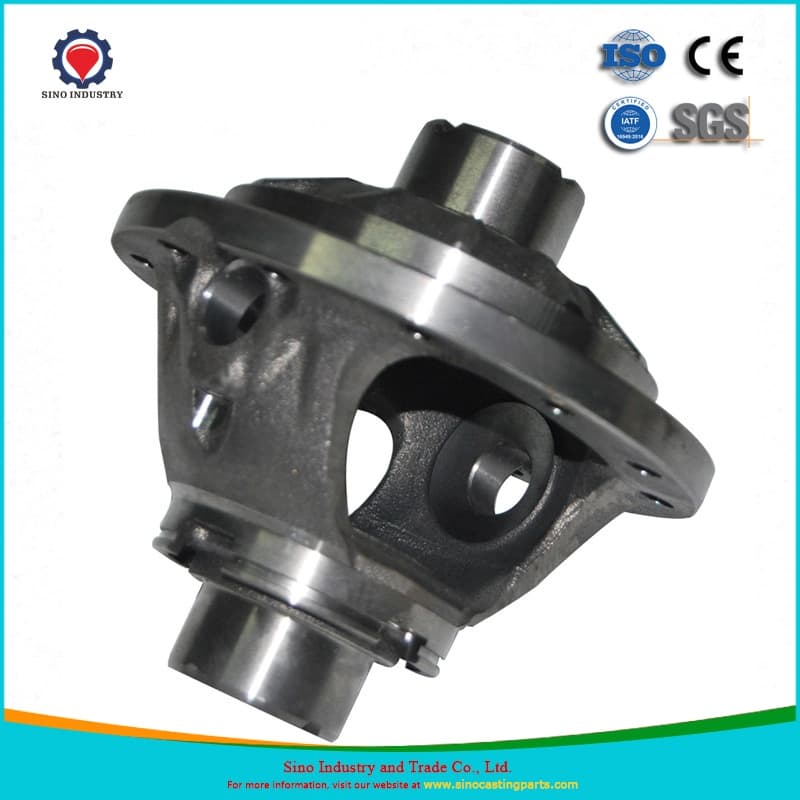
Working with near-net-shape raw materials introduces unique implementation realities. Castings and forgings rarely arrive featuring perfectly square starting surfaces. They possess draft angles, parting lines, and unpredictable flash. You must adapt your machining strategy to handle these inconsistencies.
Multi-sided accessibility solves major manufacturing bottlenecks. machining forged metal parts often requires complex secondary finishing. You might need to drill angled holes, flatten bosses, and face mating surfaces. Multi-axis setups allow you to complete these features using a single clamping. You do not have to design custom angled fixtures for every single hole. The machine table simply rotates the forging into the correct orientation.
Datum alignment risks cause significant scrap during secondary operations. A casting might shift slightly as it cools. CNC machining for cast parts relies heavily on advanced spindle probes. The 5-axis machine uses the probe to touch the raw casting. Software then compensates for slight dimensional variations before any cutting begins. The machine virtually aligns the toolpath to the actual physical part. This automated alignment slashes scrap rates and ensures uniform wall thicknesses.
Material considerations also dictate machine selection. Forgings often utilize incredibly hard materials. Titanium, Inconel, and duplex stainless steel require immense cutting forces. You need high machine rigidity to conquer them. The chosen 5-axis center must prioritize trunnion stability. If the machine lacks a robust trunnion, the hard metal will push the tool away. This deflection destroys tolerances and breaks expensive cutters.
You must break down the technical distinction between machine types. This knowledge prevents you from over-specifying requirements. Over-specifying immediately inflates your quotes. Let us evaluate the exact differences.
3+2 Positional Machining: This method locks the fourth and fifth axes during cutting. The machine rotates the part into position, locks the brakes, and performs standard 3-axis cutting. It works best for multi-sided parts featuring flat but angled planes. Engine blocks and complex brackets fit this profile perfectly. It carries a lower cost impact. The programming complexity remains manageable, and the machine costs less than a simultaneous unit.
Simultaneous 5-Axis: This method moves all axes simultaneously while the tool touches the metal. It works best for organic shapes and continuous toolpaths. It commands the highest hourly rate.
We must address a critical reality check regarding tolerances. A dangerous misconception exists in the market. Many buyers believe cheap or entry-level 5-axis machines can hold tight tolerances. They expect accuracy below 0.01mm on hard metals at high speeds. True high-precision commercial output requires heavy-duty, thermally stable equipment. Entry-level machines lack spindle chillers and linear scales. As they heat up, the metal framework expands. This expansion destroys your 0.01mm tolerance limit. You must partner with vendors utilizing commercial-grade, climate-controlled equipment.
Summary Chart: Comparing Multi-Axis Technologies
Feature | 3+2 Positional Machining | Simultaneous 5-Axis Machining |
|---|---|---|
Tool Movement | Spindle moves in 3 axes; part remains locked during cut. | Tool and part move concurrently across 5 axes. |
Ideal Geometries | Prismatic parts, angled holes, flat faces on multiple sides. | Organic curves, impellers, turbine blades, sweeping contours. |
Setup Efficiency | High (reduces manual flipping). | Very High (completes complex parts in one setup). |
Cost Impact | Moderate hourly rate; lower programming costs. | Premium hourly rate; requires advanced CAM software. |
Surface Finish | Excellent for flat planes. | Superior for contoured, flowing geometries. |
You need actionable steps to evaluate a vendor's capabilities. Looking at an equipment list does not guarantee quality. A shop might own a premium machine but lack the talent to run it. You must investigate their internal processes.
You must demand First Article Inspection (FAI) reports. Complex multi-axis parts require rigorous metrology. Standard hand tools cannot measure compound angles accurately. You must verify their Coordinate Measuring Machine (CMM) capabilities. The vendor should provide a CMM report validating the geometric dimensioning and tolerancing (GD&T) callouts. If they cannot produce this documentation, they cannot guarantee multi-axis accuracy.
The machine is only as good as the programmer. Inefficient 5-axis toolpaths lead to disastrous outcomes. Poor programming causes machine collisions, which destroy spindles. It also creates excessive cycle times. A highly skilled programmer uses advanced CAM software to optimize tool engagement. They ensure the tool removes metal smoothly without overloading the spindle. Ask potential vendors about their CAM software and programmer training programs.
You must evaluate the partner's capacity for scale. Can they handle your production volumes reliably? Investigate their material traceability protocols. Aerospace and medical industries demand strict compliance. The vendor must provide material test reports (MTRs) for every batch. Finally, assess their ability to handle secondary processes. Do they manage heat treatment, anodizing, or specialized coating? A partner handling these steps internally or through vetted local networks mitigates major supply chain risks.
Best Practices for Vetting Vendors:
Request case studies featuring materials similar to your project.
Audit their climate control systems; temperature fluctuations ruin tight tolerances.
Verify their spindle hours and machine maintenance logs.
Ask how they handle tool wear compensation during long production runs.
Common Mistakes to Avoid:
Choosing a vendor based solely on the lowest hourly rate.
Ignoring the vendor's inspection equipment limitations.
Failing to provide native 3D CAD files alongside 2D PDF drawings.
5-axis CNC machining remains a highly strategic choice. It excels at consolidating setups, managing compound geometries, and holding tight geometrical tolerances across multiple planes. You must evaluate this technology as a business investment rather than a simple shop-floor upgrade. True ROI emerges when you eliminate manual re-fixturing and drastically reduce scrap rates.
We advise you to audit your current part catalog immediately. Look for components suffering from tolerance stacking issues. Identify parts requiring more than three separate machine setups. If fixturing costs are eroding your profit margins, a transition to multi-axis manufacturing is definitely warranted. Positional 3+2 setups might solve your bottleneck without the simultaneous price tag.
Submit your 3D CAD model to an experienced manufacturing partner today. Request a comprehensive manufacturability review. This step provides a data-driven cost comparison between standard 3-axis and advanced 5-axis approaches. Make your next supply chain decision using concrete production data.
A: Per hour, yes. Per part, not necessarily. If a part requires four different 3-axis setups, the labor and fixturing costs often exceed a single 5-axis setup. You save money by eliminating manual intervention and reducing overall cycle times.
A: Yes, primarily by eliminating the "tolerance stacking" phenomenon. Tolerance stacking occurs when a part is manually unclamped, flipped, and reclamped multiple times. Keeping the part locked in a single fixture guarantees relational accuracy between all machined features.
A: The process is material-agnostic. However, high-value materials like titanium, Inconel, and superalloys often justify the process. Reducing scrap on expensive raw materials yields significant cost savings. Furthermore, optimizing tool life via ideal cutting angles helps offset the higher machine rate.
A: Standard 3D CAD models, such as STEP, IGES, or Parasolid, are perfectly sufficient. The actual complexity lies in the CAM software used by the machinist. They use your base design file to generate the complex multi-axis toolpaths.


